

The Thermal and Particulate Mechanisms Accelerating HVAC Wear
The Sierra Foothills’ unique climate presents a formidable challenge to residential air conditioning systems. The combination of prolonged extreme heat and pervasive wildfire smoke creates a synergistic effect that accelerates wear and tear, leading to premature system degradation. We observe a cycle where high ambient temperatures force AC units to work harder, while fine particulate matter from smoke infiltrates and clogs critical components, exacerbating the thermal strain. This constant battle against environmental stressors significantly shortens AC life expectancy.


Extreme Heat Load, Compressor Strain, and Thermal Breakdown
The relentless summer heat waves in the Sierra Foothills push air conditioning systems to their operational limits. When ambient temperatures soar, AC units must run almost continuously to maintain indoor comfort, leading to prolonged periods of high thermal load. This constant cycling and extended operation place immense strain on the compressor, the heart of the AC system. Compressors are susceptible to overheating, which can lead to increased head pressure within the refrigerant lines. Elevated temperatures can also accelerate the breakdown of refrigerant oil, reducing its lubricating properties and increasing friction within the compressor’s moving parts.
Beyond the compressor, other electrical components suffer. Thermal expansion and contraction from continuous operation can stress electrical connections and insulation. Run capacitors, vital for starting and running the compressor and fan motors, are particularly vulnerable to electrical fatigue and heat-induced degradation, often failing prematurely under these conditions. The overall effect is an accelerated aging of the entire system, as components are constantly pushed beyond their optimal operating parameters.
Fine Particulate Matter Infiltration and Airflow Resistance
While heat stresses the mechanical and electrical aspects, wildfire smoke introduces a different, yet equally destructive, threat: fine particulate matter (PM2.5) and soot. These microscopic aerosols, often less than 2.5 micrometers in diameter, are small enough to bypass many conventional filters and infiltrate both outdoor and indoor AC components. Research indicates that during wildfire events, mean indoor PM2.5 concentrations can nearly triple, even as building infiltration ratios decrease due to occupants sealing their homes. This underscores the pervasive nature of smoke particles.
Outdoors, soot accumulation on condenser coil fins acts as an insulating layer, impeding the critical heat transfer process. This forces the compressor to work even harder and longer to dissipate heat, compounding the thermal stress already imposed by high ambient temperatures. Indoors, PM2.5 and soot can coat evaporator coils, reducing their ability to absorb heat from the indoor air. More critically, these particles can clog air filters, leading to a significant increase in static pressure within the ductwork. This restricted airflow forces the blower motor to work harder, consuming more energy and increasing the risk of premature failure due to bearing wear or thermal cutoff. The cumulative effect of particulate deposition is reduced system efficiency, increased energy consumption, and accelerated component degradation.
Smoke Chemistry: Prescribed Burns vs. High-Severity Wildfires
Understanding the chemical composition of smoke is crucial, as not all smoke impacts AC systems equally. The type of fire, the fuels consumed, and the combustion phase all influence the emission profile, which in turn dictates the potential for particulate loading and corrosive damage to HVAC equipment.

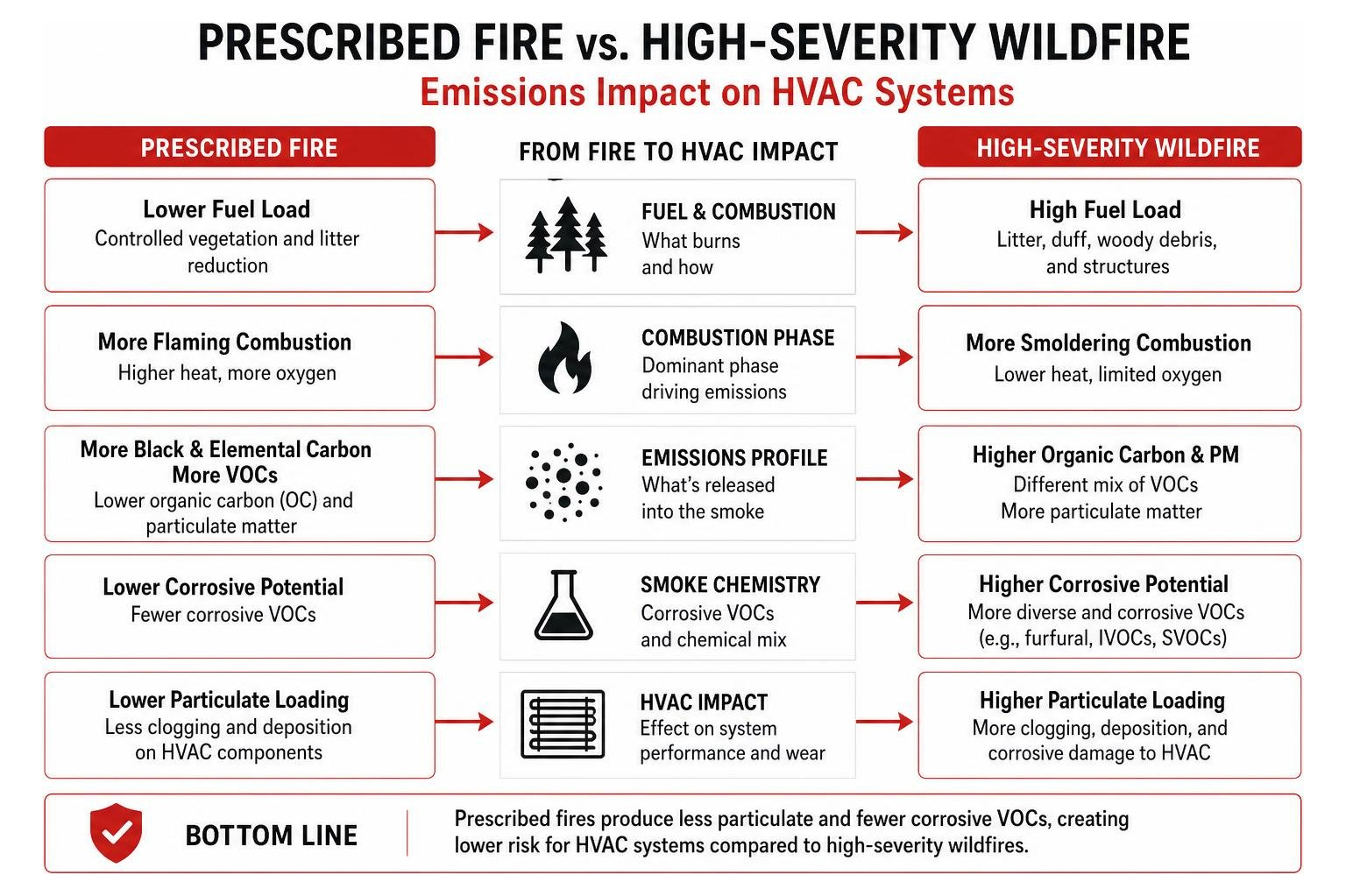
Fuel Loading, Combustion Phases, and Corrosive VOC Profiles
The Sierra Nevada mixed conifer forests are characterized by varying fuel loads, including duff layers, litter, and woody debris. The way these fuels burn significantly affects the smoke’s chemical makeup. During a fire, there are generally two main combustion phases: flaming and smoldering. The flaming phase, characterized by higher temperatures and rapid oxidation, tends to produce more black carbon (BC) and elemental carbon (EC), along with a range of volatile organic compounds (VOCs). The smoldering phase, occurring at lower temperatures with limited oxygen, often produces higher amounts of organic carbon (OC), particulate matter, and a different suite of VOCs, some of which can be highly corrosive.
Research shows that biomass burning is a dominant source of primary carbonaceous aerosols and non-methane organic compounds, including VOCs, intermediate VOCs (IVOCs), and semi-VOCs (SVOCs). Some of these VOCs, such as furfural, which has been identified as a dominant VOC from biomass burning, can contribute to the corrosive nature of smoke. These corrosive gases, even in low concentrations, can react with metal surfaces in AC coils and electrical components, leading to material degradation over time. The specific mix of these compounds depends heavily on the type and amount of fuel consumed. For instance, burning of structural materials during high-severity wildfires in the wildland-urban interface (WUI) can introduce a different, potentially more damaging, array of chemicals compared to natural vegetation fires.
Blodgett Forest Research and Mixed Conifer Emission Factors
To better understand and manage smoke impacts, extensive research has been conducted, including studies at the Blodgett Forest Research Station in Sierra Nevada mixed conifer forests. These studies have focused on characterizing emission factors from prescribed burns, offering valuable insights into the differences between controlled burns and uncontrolled wildfires.
Prescribed burns are designed to reduce fuel loads, lessening the severity and emissions of future wildfires. For example, studies have shown that prescribed burns can reduce total ground and surface fuel load by 53% and litter/fine woody debris by 65%. The grand mean PM2.5 emission factor from mixed conifer prescribed fires was approximately 35.6 g/kg of fuel burned. Organic carbon (OC) emission factors averaged 19.4 g/kg.
A key distinction lies in the concentration and dilution of emissions. While prescribed burns do release PM2.5 and VOCs, they are often conducted under specific atmospheric conditions that promote dispersion, leading to lower ambient concentrations compared to large, uncontrolled wildfires. Wildfire smoke samples, even from significant events like the Springs and Kincade fires, often show lower mixing ratios of many VOCs compared to concentrated prescribed burn samples, largely due to dilution and reactive losses during transport over larger distances. However, the sheer volume and intensity of a wildfire can overwhelm dilution effects, leading to much higher ground-level concentrations of pollutants and a more potent mix of corrosive and particulate-laden smoke that directly impacts AC systems. These differences underscore why proactive fuel management through prescribed burns is a critical strategy for mitigating the long-term impact of smoke on both air quality and infrastructure like HVAC systems.
Vulnerable HVAC Components and Failure Points
The combined assault of extreme heat and wildfire smoke targets several critical components within an AC unit, leading to accelerated wear, component breakdown, and eventual mechanical failure. Identifying these vulnerable points is key to understanding why AC life expectancy is reduced in the Sierra Foothills.

Condenser Coils, Evaporator Coils, and Fan Motor Stress
The outdoor condenser coil and indoor evaporator coil are perhaps the most susceptible to smoke-related damage. The delicate aluminum fins and copper tubing that make up these coils are designed for efficient heat transfer. However, wildfire smoke carries a sticky, greasy residue of soot and particulate matter that coats these surfaces. This coating acts as an insulator, significantly reducing the coils’ ability to dissipate heat (condenser) or absorb heat (evaporator). This reduced heat transfer efficiency forces the system to run longer and harder to achieve the desired temperature, leading to increased energy consumption and accelerated wear on the compressor.
Furthermore, the chemical components within smoke, particularly corrosive VOCs, can react with the metals in the coils, leading to pitting and corrosion of the aluminum fins and copper tubing over time. This structural degradation can compromise the integrity of the coils, potentially leading to refrigerant leaks.
The fan motors, both in the outdoor condenser unit and the indoor air handler, are also under increased stress. The condenser fan motor works harder to pull air through soot-laden coils, while the indoor blower motor struggles against restricted airflow caused by clogged filters and coated evaporator coils. This increased workload leads to accelerated bearing wear, higher operating temperatures for the motors, and a greater risk of thermal cutoff or premature motor failure.
Filter Saturation and Indoor Air Infiltration Dynamics
Air filters are the first line of defense against particulate matter, but during wildfire events, they can quickly become overwhelmed. Smoke particles, especially PM2.5, rapidly saturate filters, causing a significant increase in pressure drop across the filter. This means the blower motor has to work much harder to pull air through the restricted filter, leading to higher energy consumption and increased strain on the motor. If filters are not changed frequently, this can lead to reduced airflow, decreased system efficiency, and even system shutdown.
Even with robust filtration, indoor air quality can be severely impacted. Research using PurpleAir sensor data from California buildings during wildfire events between 2018-2020 revealed that while infiltration ratios (the proportion of outdoor PM2.5 that makes it indoors) decreased from 0.4 on non-fire days to 0.2 during wildfires, mean indoor PM2.5 concentrations still nearly tripled. This indicates that despite efforts to seal building envelopes, a substantial amount of smoke still infiltrates indoor spaces, reaching the evaporator coil and other internal components. This indoor infiltration means that even the indoor parts of your AC system are exposed to the damaging effects of smoke, contributing to overall system degradation and shortening its operational lifespan.
Baehr AC Life Extension: Maintenance and Mitigation Checklist
Proactive maintenance and strategic mitigation are essential for safeguarding your AC system against the dual threats of Sierra Foothill heat and wildfire smoke. Implementing a comprehensive plan can significantly extend your AC life expectancy and ensure consistent indoor comfort.
For homeowners seeking to maximize their system’s resilience and longevity, understanding specific strategies is key. We recommend exploring resources like Baehr AC life extension for further insights into maintaining your system in challenging environments. This guide provides an excellent starting point for developing your own maintenance and protection strategy.
Baehr AC Life Extension Protocols During Active Wildfire Events
When wildfire smoke is present, immediate actions can help protect your AC unit:
- Switch to Recirculation Mode: If your AC system has a fresh-air intake or economizer, switch it to “recirculation” or “closed” mode to prevent drawing smoky outdoor air into your home. Ensure fresh-air dampers are fully closed.
- Upgrade Air Filters (Carefully): While your system is running, use the highest MERV (Minimum Efficiency Reporting Value) rated filter your HVAC system can handle without straining the blower motor. MERV 13 filters are generally effective against PM2.5 from smoke and are often a good balance for residential systems. However, consult with an HVAC professional to ensure a higher MERV filter won’t restrict airflow too much, which could damage your blower motor.
- Consider Pre-Filter Staging: For extremely smoky conditions, some homeowners use a coarse pre-filter in conjunction with a finer filter to extend the life of the more expensive MERV-rated filter.
- Utilize Auxiliary Purification: Portable air purifiers with HEPA filters can significantly reduce indoor PM2.5 concentrations, taking some of the burden off your central AC system.
- Thermostat Management: Avoid setting your thermostat to excessively low temperatures. This reduces the continuous run time of your AC, lessening the strain on components already working harder due to heat and potential smoke residue.
Post-Fire Recovery and Long-Term Baehr AC Life Extension Strategies
Once the immediate threat of smoke has passed, a thorough post-fire recovery plan is crucial for long-term system health:
- Professional Coil Cleaning: Schedule a professional HVAC cleaning. Technicians can perform coil foaming and chemical rinses on both condenser and evaporator coils to remove embedded soot and particulate matter. This restores heat transfer efficiency and prevents corrosive damage.
- Electrical System Check: Have a technician inspect and test electrical components, especially run capacitors, which are prone to premature failure under heat and heavy load.
- Ductwork Inspection and Cleaning: Smoke can infiltrate and settle in ductwork. Consider professional duct cleaning to remove residual smoke particles and odors, improving indoor air quality and preventing them from being recirculated.
- Airflow Rebalancing and System Diagnostics: A professional can rebalance your system’s airflow and perform comprehensive diagnostics to ensure all components are operating within specifications after the smoke event.
- Duct Sealing: Improve your home’s building envelope by sealing duct leaks. This not only prevents smoke infiltration but also improves overall system efficiency and reduces energy waste.
- Regular Seasonal Tune-ups: Beyond wildfire season, commit to regular preventive maintenance. Seasonal tune-ups ensure your system is clean, calibrated, and operating efficiently, which is the best defense against environmental stressors.
Frequently Asked Questions About Sierra Foothill AC Longevity
Homeowners in the Sierra Foothills often have specific concerns about how the region’s climate impacts their cooling systems. Here, we address some common questions regarding AC life expectancy in the face of heat and wildfire smoke.
How much does wildfire smoke reduce the lifespan of an AC unit?
While specific quantitative data directly linking wildfire smoke exposure to a precise reduction in AC unit lifespan is still an emerging area of research, the mechanisms of degradation are well-understood. Wildfire smoke, particularly its fine particulate matter (PM2.5) and corrosive volatile organic compounds (VOCs), significantly accelerates wear and tear on critical AC components.
The accumulation of soot on condenser and evaporator coils reduces heat transfer efficiency, forcing the compressor to work harder and longer. This increased operational strain, combined with the thermal stress from extreme heat, leads to premature failure of components like compressors, fan motors, and capacitors. Corrosive elements in smoke can also degrade metal surfaces, leading to leaks and material breakdown.
Therefore, while we cannot provide an exact number of years, it is clear that AC units exposed to frequent and intense wildfire smoke, especially in conjunction with high heat, will experience a shortened operational lifespan and an increased likelihood of premature failure compared to systems in less affected environments. This necessitates more frequent maintenance and potentially earlier replacement.
What is the difference in AC damage between prescribed burns and wildfires?
The difference in AC damage largely stems from the variations in emission profiles, heat intensity, and pollutant concentrations between prescribed burns and uncontrolled wildfires.
- Prescribed Burns: These are managed fires designed to reduce fuel loads. They are typically conducted under specific atmospheric conditions that promote smoke dispersion, resulting in lower ambient PM2.5 and VOC concentrations. While they still release pollutants, the smoke is generally less concentrated and often less chemically complex than wildfire smoke. The impact on AC systems is typically less severe, primarily involving light particulate accumulation that can be managed with regular filter changes and professional coil cleaning. The heat intensity is also much lower, posing minimal direct thermal threat to AC units.
- Wildfires: Uncontrolled wildfires, especially high-severity events, burn larger areas, consume more diverse fuels (including structures in WUI areas), and generate significantly higher heat intensity. This leads to massive emissions of highly concentrated PM2.5, black carbon, and a broader, more reactive mix of VOCs. These pollutants can be highly corrosive and dense, leading to rapid and heavy soot accumulation on coils, deeper infiltration into electrical components, and more aggressive chemical degradation of materials. The sheer volume and intensity of wildfire smoke can overwhelm filtration systems and lead to substantial, rapid damage to AC units, requiring extensive cleaning and potentially component replacement.
While both types of fires produce smoke, wildfires pose a much greater and more immediate threat for substantial and corrosive damage to AC systems due to their scale, intensity, and chemical output.
What filter MERV rating is best for wildfire smoke without straining the blower motor?
For effective filtration of wildfire smoke without unduly straining your AC system’s blower motor, a MERV 13 filter is generally considered the optimal choice for most residential HVAC systems.
- MERV 13 filters are highly effective at capturing fine particulate matter (PM2.5), which is the primary component of wildfire smoke that causes health issues and AC damage. They can capture over 90% of particles between 3-10 microns and over 75% of particles between 0.3-1.0 microns, including smoke, smog, and bacteria.
- Static Pressure and Motor Strain: While higher MERV ratings (e.g., MERV 14-16) offer even better filtration, they also create a greater static pressure drop across the filter. This increased resistance forces your blower motor to work harder, which can lead to reduced airflow, higher energy consumption, premature motor wear, or even system damage if the motor is not designed for such resistance.
- Professional Consultation: It is always recommended to consult with a qualified HVAC technician before upgrading to a higher MERV filter, especially if your system is older or you are considering MERV 14 or above. They can assess your specific system’s capabilities and ensure that the chosen filter won’t compromise airflow or motor longevity.
Therefore, for most Sierra Foothill homes, a MERV 13 filter strikes a good balance between effective smoke filtration and maintaining healthy system operation.
Conclusion
The Sierra Foothills, with its escalating heat waves and more frequent, intense wildfire seasons, presents a unique and growing challenge to the longevity of residential air conditioning systems. We have seen how the relentless thermal strain on compressors and electrical components, combined with the insidious infiltration and corrosive effects of wildfire smoke, creates a powerful synergy that accelerates AC degradation. From clogged coils and overworked fan motors to compromised indoor air quality, the impacts are profound.
However, understanding these threats empowers homeowners to take proactive steps. By implementing a diligent maintenance regimen, adopting smart mitigation strategies during smoke events, and ensuring thorough post-fire recovery protocols, we can significantly enhance system resilience and extend AC life expectancy. Protecting your cooling system is not just about comfort; it’s about safeguarding a vital investment in the face of our changing Sierra climate.

